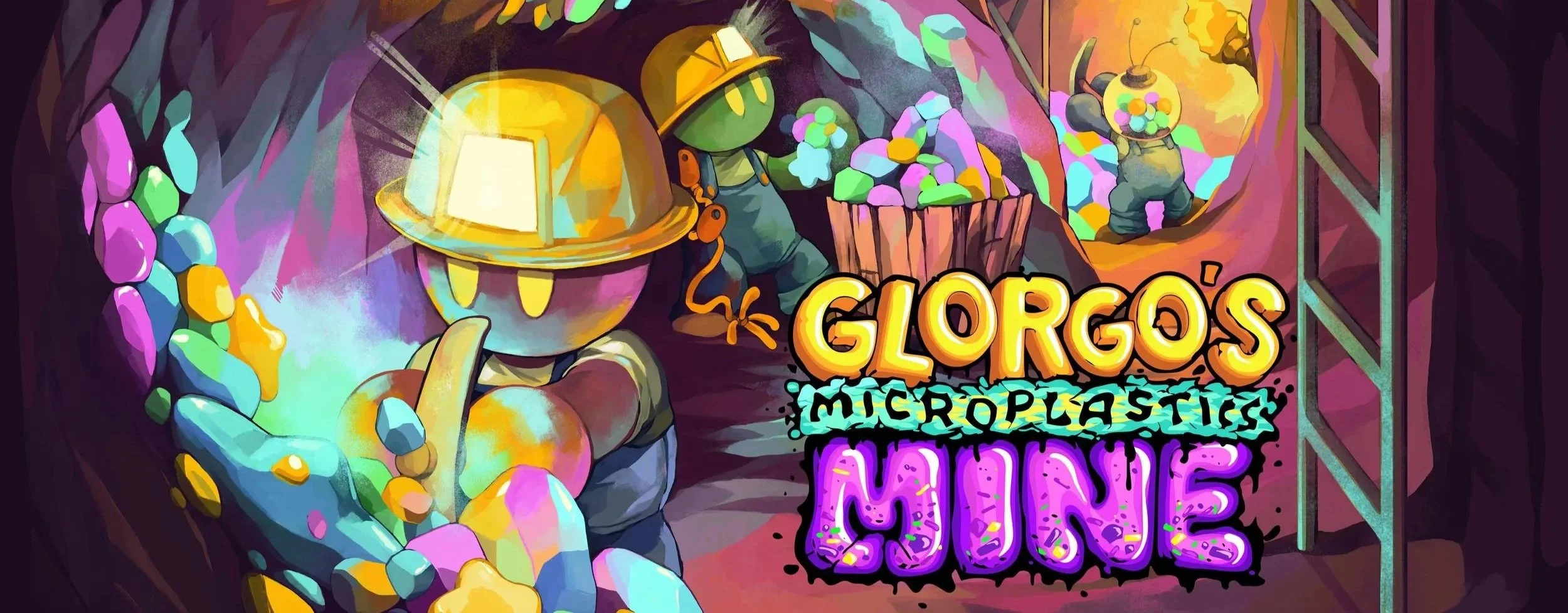
Glorgo’s Microplastics Mine is a student-made 2.5D incremental game released on Steam in May 2026. Clock in to the most absurd contract shift of your life in Glorgo’s Microplastics Mine, a brilliant Y2k-themed, eccentric incremental resource manager that rattles the senses while you’re tasked with overseeing the small but mighty workforce under you who are sent into the alien mines to retrieve the precious microplastics your scheming boss desires.
On the project, I lead a team of 10 artists through the entire production process to bring the absurd world of Glorgo to life. My responsibilities included assigning, tracking, and scheduling tasks for a weekly sprint system, collaborating with the design, narrative, and engineering teams to plan out the scope and pipelines of the project, and researching and prototyping complex tech art systems to present innovative solutions to the director and faculty overseeing the process, all over the span of 10 months.
Play Glorgo’s Microplastics Mine on PC and Mac, available on Steam and itch.io.
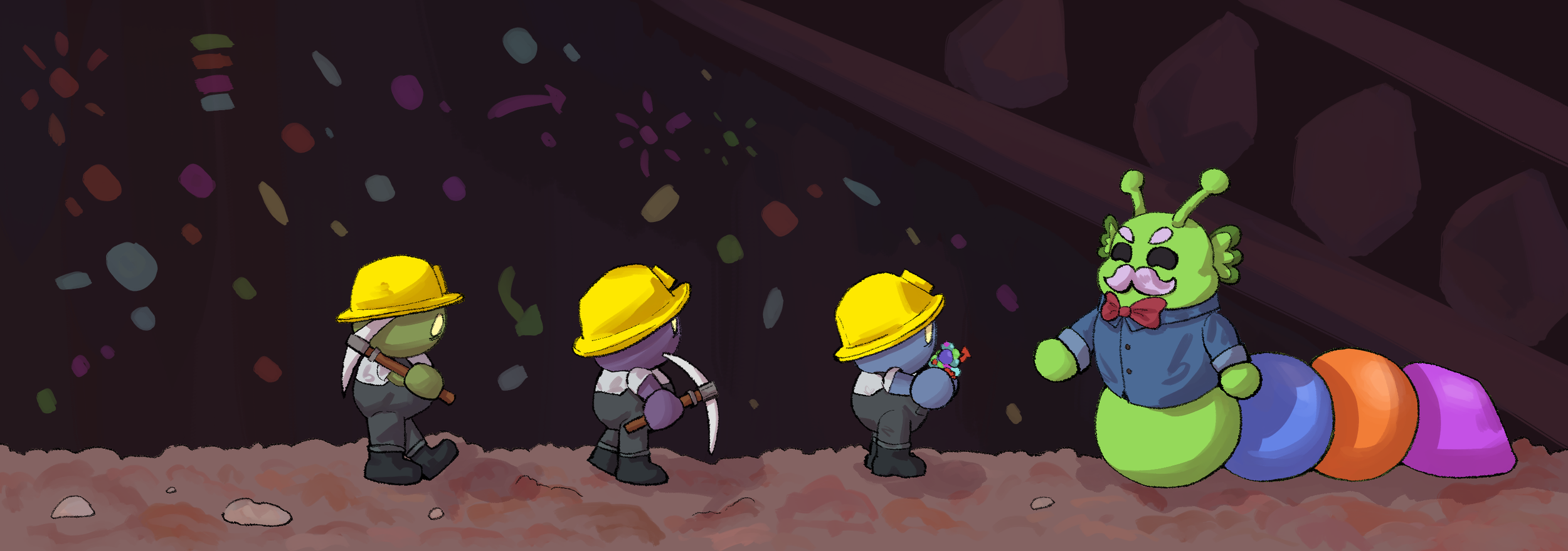
Miners,
Monsters,
& lots of plastic
To create a rich 2.5D world, I contrasted the the 3D player and enemy characters and the plastic ore props with 2D environments and backgrounds. I was able to establish a specialized pipeline that included concepts, modelling, texturing, rigging, animation, and implementation.
I directed geometries and textures to be made with simplified shapes and high-contrast colors in consideration of the large number of objects that appear as the player progresses through the incremental game. I also worked with the engineering team and oversaw the creation of 3D assets and animations to maintain performance during high-density parts of the game.
modular characters
One of the key design spaces of Glorgo’s is the mutation feature. As players progress through the game, the increased blood microplastic concentration (BMC) of their miners causes them to spontaneously mutate, changing their bodies.
I tackled the unique technical art challenge of modular characters, innovating solutions so that miners and enemies could have individually modeled and animated segments that could be swapped out at runtime.
Using Autodesk Maya’s referencing & layering features, animators were able to create over 70 animations spread across 9 configurations of the miner character to reflect the new behaviors of mutated limbs.
Similarly, the multiple segments of enemies were animated individually and connected in-engine so they can appear at different lengths and shorten as they suffer damage in combat.
environments
To frame the bright 3D elements of the game, I chose to have environments and backgrounds be made entirely in 2D. Backgrounds were illustrated then placed in parallax with the foreground, with much attention paid to their color schemes and level of detail as to not distract the player in an already crowded environment.
The “cell” system that makes up the entire interactable space of the mine area was accomplished via tilemap-like sprites that wrap seamlessly. I was also able to develop a custom shader using Unity’s ShaderGraph functionality that generates a black outline around sprites & that updates in real-time in response to players destroying surrounding cells, which allowed us to update and tweak cell sprites at any time while maintaining the seamless connections of the environment.